


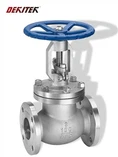

What is the pressure drop across an Alloy Steel Globe Valve?
Hey there! I'm a supplier of Alloy Steel Globe Valves, and I often get asked about the pressure drop across these valves. So, let's dive right in and break it down.


First off, what exactly is a pressure drop? Well, it's the difference in pressure between the inlet and the outlet of a valve. When fluid (it could be a liquid or a gas) flows through an Alloy Steel Globe Valve Alloy Steel Globe Valve, it encounters resistance. This resistance causes a decrease in pressure as the fluid moves from one side of the valve to the other.
Now, why does this matter? The pressure drop across a valve can have a significant impact on the overall performance of a piping system. If the pressure drop is too high, it can lead to increased energy consumption. Think of it like trying to push water through a narrow pipe. The narrower the pipe, the more effort you need to put in to get the water flowing. Similarly, a high - pressure drop in a valve means that the pumps or compressors in the system have to work harder, which in turn increases operating costs.
There are several factors that affect the pressure drop across an Alloy Steel Globe Valve. One of the main factors is the valve's design. Globe valves have a relatively complex internal structure compared to some other types of valves. The fluid has to change direction multiple times as it passes through the valve, which creates more resistance and thus a higher pressure drop. For example, the flow path in a globe valve is often more convoluted than in a ball valve. In a ball valve, the fluid can flow more or less straight through when the valve is fully open, resulting in a lower pressure drop.
The size of the valve also plays a role. A smaller - sized Alloy Steel Globe Valve will generally have a higher pressure drop than a larger one. This is because the flow area is smaller, and the fluid has to squeeze through a tighter space. It's like trying to pour a large amount of water through a small funnel. The water will flow more slowly, and there will be more resistance.
The flow rate of the fluid is another important factor. As the flow rate increases, the pressure drop across the valve also increases. This is because at higher flow rates, the fluid is moving faster, and the forces acting on it are greater. So, if you have a system with a high - flow rate, you need to be especially careful about the pressure drop across the valve.
The type of fluid being used can also affect the pressure drop. Viscous fluids, like oil, will generally cause a higher pressure drop than less viscous fluids, such as water. This is because viscous fluids have more internal friction, and they resist flow more strongly.
Now, let's talk about how to calculate the pressure drop across an Alloy Steel Globe Valve. There are several methods and equations available for this. One of the most commonly used equations is the Darcy - Weisbach equation, which takes into account factors such as the length of the pipe, the diameter of the pipe, the roughness of the pipe wall, and the velocity of the fluid. However, for valves, manufacturers often provide flow coefficient (Cv) values. The Cv value is a measure of the valve's capacity to pass fluid. By using the Cv value and the flow rate of the fluid, you can calculate the pressure drop across the valve.
If you're in the market for a valve with a lower pressure drop, you might also consider a Cast Steel Globe Valve. Cast steel globe valves can sometimes offer a more cost - effective solution with a relatively lower pressure drop, depending on your specific application.
As a supplier of Alloy Steel Globe Valve, I know that choosing the right valve for your system is crucial. You need to balance factors such as pressure drop, cost, durability, and ease of maintenance. That's where I come in. I can help you select the right Alloy Steel Globe Valve for your specific needs. Whether you have a high - flow system or a system that uses a viscous fluid, I can recommend a valve that will minimize the pressure drop and keep your system running efficiently.
If you're interested in learning more about Alloy Steel Globe Valves or have any questions about pressure drop, don't hesitate to reach out. We can have a detailed discussion about your system requirements and find the best valve solution for you. Whether you're a small - scale industrial operation or a large - scale manufacturing plant, I'm here to assist you in making the right choice.
In conclusion, understanding the pressure drop across an Alloy Steel Globe Valve is essential for optimizing the performance and efficiency of your piping system. By considering factors like valve design, size, flow rate, and fluid type, you can make an informed decision when selecting a valve. And if you need any help along the way, I'm just a message away. Let's work together to find the perfect valve for your needs and get your system running at its best.
References
- Crane Technical Paper No. 410, "Flow of Fluids Through Valves, Fittings, and Pipe"
- Perry's Chemical Engineers' Handbook, McGraw - Hill