


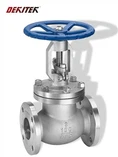

Hey there! I'm a supplier of globe valves, and today I wanna chat about the installation orientation requirement for a globe valve. It's a topic that might seem a bit technical at first, but it's super important for getting the most out of these valves.
First off, let's understand what a globe valve is. A globe valve is a type of valve used for regulating flow in a pipeline. It's got a disk that moves up and down to control the amount of fluid passing through. And the way you install it can have a big impact on how well it works.
One of the most common installation orientations for a globe valve is the "flow under the seat" orientation. In this setup, the fluid enters the valve from the bottom of the seat and flows upwards. This orientation has several advantages. For starters, it reduces the force required to open and close the valve. When the fluid is flowing from below, it helps to lift the disk, making it easier to operate. This is especially useful in applications where you need to open and close the valve frequently.
Another benefit of the "flow under the seat" orientation is that it helps to minimize wear and tear on the valve components. The fluid flow tends to wash away any debris or particles that might otherwise get stuck in the valve, reducing the risk of damage. This can extend the lifespan of the valve and save you money on maintenance and replacement costs in the long run.
However, there are also some situations where the "flow over the seat" orientation might be more appropriate. In this setup, the fluid enters the valve from the top of the seat and flows downwards. This orientation is often used in applications where you need to prevent backflow or where the valve needs to be able to withstand high pressures.
When the fluid is flowing from above, it creates a seal that helps to prevent the fluid from flowing back in the opposite direction. This can be crucial in systems where backflow could cause damage or safety issues. Additionally, the "flow over the seat" orientation can provide better sealing performance under high pressures, as the pressure of the fluid helps to keep the disk firmly seated.
But it's not all sunshine and rainbows with the "flow over the seat" orientation. One of the main drawbacks is that it requires more force to open and close the valve. The fluid pressure is pushing down on the disk, making it harder to lift. This can be a problem in applications where you need to operate the valve manually or where the valve needs to be opened and closed quickly.
So, how do you decide which installation orientation is right for your application? Well, it really depends on a few factors. First, you need to consider the type of fluid that will be flowing through the valve. Some fluids are more corrosive or abrasive than others, and this can affect the choice of orientation. For example, if you're dealing with a fluid that contains a lot of particles, the "flow under the seat" orientation might be better to prevent the particles from getting stuck in the valve.
You also need to think about the operating conditions of the system. What is the pressure and temperature of the fluid? How often will the valve need to be opened and closed? These factors can all influence the performance of the valve and the choice of installation orientation.
In addition to the fluid and operating conditions, you also need to consider the specific requirements of your application. For example, if you need to prevent backflow, the "flow over the seat" orientation might be the way to go. On the other hand, if you need to minimize the force required to operate the valve, the "flow under the seat" orientation might be more suitable.


As a globe valve supplier, I've seen firsthand the importance of getting the installation orientation right. That's why I offer a wide range of globe valves, including Duplex Steel Globe Valve and Alloy Steel Globe Valve. These valves are designed to meet the needs of different applications and can be installed in either the "flow under the seat" or "flow over the seat" orientation.
Whether you're looking for a valve for a small-scale project or a large industrial application, I've got you covered. My team of experts can help you choose the right valve and installation orientation for your specific needs. We can also provide you with all the information and support you need to ensure a successful installation.
If you're interested in learning more about globe valves or if you have any questions about installation orientation, don't hesitate to get in touch. I'm always happy to chat and help you find the best solution for your application. Whether you're a DIY enthusiast or a professional engineer, I'm here to support you every step of the way.
In conclusion, the installation orientation of a globe valve is a crucial factor that can have a significant impact on its performance and lifespan. By considering the type of fluid, operating conditions, and specific requirements of your application, you can choose the right orientation to ensure optimal performance. And if you need help along the way, I'm just a message away. So, why wait? Contact me today to discuss your globe valve needs and let's get started on finding the perfect solution for you.
References
- Valves Handbook: A Guide to Valve Selection, Sizing, and Installation
- Fluid Mechanics and Thermodynamics of Turbomachinery, S. L. Dixon
- Process Piping Design, George A. Antaki