


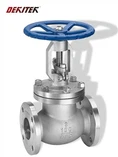

The flow coefficient, often denoted as Cv, is a critical parameter in the operation and performance of stainless steel globe valves. As a supplier of stainless steel globe valves, understanding how the flow coefficient affects flow control is essential for providing our customers with the most suitable products for their specific applications.
Understanding the Flow Coefficient
The flow coefficient (Cv) is defined as the number of US gallons per minute of water at 60°F that will flow through a valve with a pressure drop of 1 psi across the valve. In simpler terms, it is a measure of a valve's capacity to pass fluid. A higher Cv value indicates that the valve can pass more fluid for a given pressure drop.
Mathematically, the relationship between flow rate (Q), pressure drop (ΔP), and the flow coefficient (Cv) can be expressed as:
[Q = Cv\sqrt{\frac{\Delta P}{SG}}]
where Q is the flow rate in US gallons per minute, ΔP is the pressure drop across the valve in psi, and SG is the specific gravity of the fluid.
Impact on Flow Control
Flow Rate Regulation
The flow coefficient directly influences the valve's ability to regulate the flow rate. When a customer needs to control the flow of a fluid within a certain range, the appropriate valve with the right Cv value must be selected. For example, in a process where a low flow rate is required, a valve with a lower Cv value is more suitable. This is because a valve with a low Cv will restrict the flow more effectively, allowing for precise control of the small amount of fluid passing through.
Conversely, in applications where a high flow rate is necessary, such as in large - scale industrial processes, a valve with a high Cv value should be chosen. A high - Cv valve can handle a large volume of fluid with a relatively small pressure drop, ensuring that the required flow rate can be achieved without excessive energy consumption.
Pressure Drop Management
The flow coefficient also plays a crucial role in managing the pressure drop across the valve. According to the formula mentioned above, for a given flow rate and fluid specific gravity, the pressure drop is inversely proportional to the square of the flow coefficient. This means that a valve with a higher Cv value will result in a lower pressure drop for the same flow rate.
In systems where maintaining a stable pressure is critical, such as in some chemical processing plants or water distribution networks, choosing a valve with an appropriate Cv can help minimize the pressure drop. Excessive pressure drop can lead to increased energy consumption, as pumps or compressors need to work harder to overcome the resistance created by the valve.
System Efficiency
The proper selection of the flow coefficient can significantly improve the overall efficiency of the fluid - handling system. By choosing a valve with the right Cv value, the system can operate at optimal conditions, reducing energy consumption and minimizing wear and tear on other components.
For instance, in a heating, ventilation, and air - conditioning (HVAC) system, a well - selected globe valve with an appropriate Cv can ensure that the right amount of refrigerant or hot/cold water is circulated, improving the system's energy efficiency and performance.
Factors Affecting the Flow Coefficient of Stainless Steel Globe Valves
Valve Size
The physical size of the valve is one of the most significant factors affecting the flow coefficient. Generally, larger valves have higher Cv values because they have a larger flow area. As the diameter of the valve increases, more fluid can pass through the valve for a given pressure drop.
However, it is important to note that simply choosing the largest valve available is not always the best solution. Oversized valves can lead to poor flow control, as they may not be able to accurately regulate small changes in flow rate.
Valve Design
The internal design of the globe valve also has a major impact on the flow coefficient. Different valve designs, such as the plug type, disc type, or the shape of the flow path, can affect the way fluid flows through the valve.
For example, a valve with a streamlined flow path will have a higher Cv value compared to a valve with a more tortuous flow path. This is because a streamlined design reduces the resistance to fluid flow, allowing more fluid to pass through with less pressure drop.


Trim Configuration
The trim of a globe valve, which includes the disc, seat, and stem, can also influence the flow coefficient. Different trim materials and configurations can change the flow characteristics of the valve. For instance, a valve with a soft - seated trim may have a different Cv value compared to a valve with a metal - seated trim.
The shape and size of the disc can also affect the flow coefficient. A larger disc may increase the flow area, resulting in a higher Cv value, but it may also require more force to operate the valve.
Selecting the Right Flow Coefficient for Applications
When selecting a stainless steel globe valve for a specific application, several factors need to be considered to determine the appropriate flow coefficient.
Process Requirements
The first step is to understand the process requirements, including the required flow rate, pressure range, and the type of fluid being handled. For example, in a pharmaceutical manufacturing process, where precise control of the flow of a chemical solution is required, a valve with a low Cv value and high - precision control capabilities may be needed.
System Constraints
System constraints, such as available space, pressure limitations, and energy consumption requirements, also need to be taken into account. In a compact system with limited space, a smaller valve with an appropriate Cv value may be the only option.
Future Expansion
It is also important to consider future expansion plans for the system. If there is a possibility of increasing the flow rate in the future, a valve with a slightly higher Cv value than currently required may be a better choice to avoid the need for valve replacement.
Other Types of Globe Valves
In addition to stainless steel globe valves, we also offer Cast Steel Globe Valve, Alloy Steel Globe Valve, and Duplex Steel Globe Valve. Each type of valve has its own unique properties and flow characteristics, which can be suitable for different applications.
Cast steel globe valves are known for their durability and strength, making them suitable for high - pressure and high - temperature applications. Alloy steel globe valves offer enhanced corrosion resistance and mechanical properties, making them ideal for harsh environments. Duplex steel globe valves combine the advantages of both austenitic and ferritic stainless steels, providing excellent corrosion resistance and high strength.
Conclusion
The flow coefficient is a vital parameter that significantly affects the flow control of stainless steel globe valves. As a supplier, we understand the importance of selecting the right valve with the appropriate flow coefficient for each customer's specific application. By considering factors such as valve size, design, trim configuration, and process requirements, we can provide our customers with valves that offer optimal flow control, pressure drop management, and system efficiency.
If you are in need of stainless steel globe valves or any other types of globe valves for your project, we invite you to contact us for a detailed discussion. Our team of experts is ready to assist you in selecting the most suitable valve and providing you with the best solutions for your flow control needs.
References
- Crane Company. "Flow of Fluids Through Valves, Fittings, and Pipe". Technical Paper No. 410.
- Miller, D. S. "Internal Flow Systems". Cambridge University Press.
- Thulukkanam, K. "Pipe Friction Manual". CRC Press.