


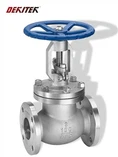

Hey there! As a supplier of globe valves, I've been dealing with these nifty pieces of equipment for quite some time. Today, I'm gonna dive into the flow characteristic of a globe valve.
First off, let's understand what a globe valve is. It's a type of valve used for regulating flow in a pipeline. It consists of a movable disk-type element and a stationary ring seat in a generally spherical body. Globe valves are pretty popular in various industries, from oil and gas to water treatment, because they offer good throttling control.
Flow Basics
The flow characteristic of a globe valve is all about how the flow rate through the valve changes as the valve opening changes. There are a few key factors that influence this characteristic, and understanding them can help you choose the right valve for your specific application.
One of the main things to consider is the valve's design. Globe valves come in different configurations, such as Z-body, Y-body, and angle-body. Each design has its own unique flow characteristics. For example, the Z-body design has a more tortuous flow path, which can result in higher pressure drops compared to the Y-body design. The Y-body design has a more streamlined flow path, allowing for better flow control and lower pressure losses.
Flow Coefficient (Cv)
Another important aspect of flow characteristic is the flow coefficient, also known as Cv. The Cv value of a valve indicates the flow capacity of the valve under specific conditions. It's a measure of how much fluid can pass through the valve at a given pressure drop. A higher Cv value means the valve can handle a larger flow rate.
When selecting a globe valve, you need to consider the required Cv value for your application. This depends on factors such as the flow rate, pressure drop, and fluid properties. You can calculate the Cv value using various formulas, but it's often easier to refer to the valve manufacturer's catalog, which usually provides Cv values for different valve sizes and configurations.
Flow Patterns
The flow pattern through a globe valve also plays a significant role in its flow characteristic. When the valve is fully open, the flow is relatively smooth and laminar. However, as the valve begins to close, the flow becomes more turbulent, and the pressure drop across the valve increases. This is because the valve restricts the flow area, causing the fluid to accelerate and create eddies and vortices.
The degree of turbulence and pressure drop depends on the valve's opening position and the design of the valve. Some globe valves are designed to minimize turbulence and pressure drop, while others are optimized for precise throttling control. For example, valves with a contoured plug or a special seat design can provide better flow control and reduce turbulence.
Types of Globe Valves and Their Flow Characteristics
Now, let's take a look at some specific types of globe valves and their flow characteristics.
Cast Steel Globe Valve
Cast Steel Globe Valve are widely used in industrial applications due to their durability and strength. They are suitable for a variety of fluids, including water, steam, and oil. Cast steel globe valves typically have a good flow coefficient and can handle moderate to high flow rates. However, their flow characteristic may be affected by the roughness of the internal surfaces, which can cause some turbulence and pressure drop.
Stainless Steel Globe Valve
Stainless Steel Globe Valve are popular in applications where corrosion resistance is required, such as in the food and beverage industry, pharmaceuticals, and chemical processing. Stainless steel valves offer excellent flow control and a smooth flow path, resulting in lower pressure drops compared to cast steel valves. They also have a high Cv value, making them suitable for applications with high flow rates.
Duplex Steel Globe Valve
Duplex Steel Globe Valve are a type of stainless steel valve that combines the strength of austenitic and ferritic stainless steels. They offer superior corrosion resistance and high strength, making them ideal for harsh environments, such as offshore oil and gas platforms and chemical plants. Duplex steel globe valves have a similar flow characteristic to stainless steel valves, with good flow control and low pressure drops.


Applications and Flow Requirements
The choice of a globe valve and its flow characteristic depends on the specific application and the flow requirements. For example, in a steam system, you may need a valve with a high Cv value to handle the large flow rate of steam. At the same time, you may also need a valve that can provide precise throttling control to maintain the desired steam pressure.
In a water treatment plant, you may need a valve that can handle a wide range of flow rates and provide good flow control to ensure the proper treatment of water. A globe valve with a linear flow characteristic may be suitable for this application, as it allows for a proportional change in flow rate as the valve opening changes.
Conclusion
In conclusion, the flow characteristic of a globe valve is a complex topic that involves factors such as valve design, flow coefficient, flow patterns, and application requirements. Understanding these factors can help you choose the right globe valve for your specific needs.
As a globe valve supplier, I can offer a wide range of high-quality globe valves, including Cast Steel Globe Valve, Stainless Steel Globe Valve, and Duplex Steel Globe Valve. If you're looking for a reliable valve solution for your application, feel free to reach out to me for more information and to discuss your specific requirements. I'm here to help you find the perfect valve for your project.
References
- "Valve Handbook" by Leslie E. Keifer
- "Fluid Mechanics" by Frank M. White