


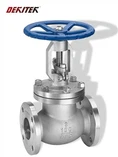

Hey there! I'm a supplier of Duplex Steel Globe Valves, and today I wanna chat about how the pressure drop across these valves varies with the flow rate. It's a topic that's super important for anyone working with fluid systems, whether you're in the oil and gas industry, chemical processing, or just a DIY enthusiast.


First off, let's quickly understand what a Duplex Steel Globe Valve is. Duplex steel is a type of stainless steel that combines the best of austenitic and ferritic steels. It's strong, corrosion - resistant, and can handle high - pressure environments. Globe valves, on the other hand, are used to regulate the flow of fluids in a pipeline. They work by moving a disc up and down against a seat to control the amount of fluid passing through.
So, how does the pressure drop change with the flow rate? Well, in a nutshell, as the flow rate increases, the pressure drop across the valve also increases. But it's not a simple linear relationship.
Let's start with the basics of fluid flow and pressure drop. When fluid flows through a valve, it has to overcome the resistance offered by the valve. This resistance is what causes the pressure drop. The pressure drop (ΔP) can be calculated using the Darcy - Weisbach equation for laminar flow or the more commonly used empirical equations for turbulent flow.
For turbulent flow, a common equation to estimate the pressure drop across a valve is the valve coefficient (Cv) equation:
[ \Delta P=\frac{Q^{2}}{C_{v}^{2}}\times SG ]
where (Q) is the flow rate, (C_{v}) is the valve coefficient, and (SG) is the specific gravity of the fluid.
The valve coefficient (C_{v}) is a measure of the valve's capacity to pass fluid. A higher (C_{v}) means the valve can pass more fluid with less pressure drop. Duplex Steel Globe Valves usually have a relatively lower (C_{v}) compared to some other types of valves like ball valves. This is because of their design, which has a more tortuous flow path.
When the flow rate is low, the pressure drop is also relatively low. The fluid can pass through the valve with ease, and the resistance it encounters is minimal. As the flow rate starts to increase, the fluid has to move faster through the valve. This increase in velocity leads to more frictional losses and more energy being dissipated, resulting in a higher pressure drop.
Let's take a real - world example. Suppose you have a pipeline in an oil refinery. At the start of the operation, the flow rate of the oil through the Duplex Steel Globe Valve might be set at a low level for testing purposes. The pressure drop across the valve is small, and the system operates smoothly. But as the refinery ramps up production and the flow rate increases, the pressure drop across the valve starts to climb.
If the pressure drop becomes too high, it can cause several problems. For one, it can reduce the efficiency of the system. The pump or compressor that is driving the fluid through the pipeline has to work harder to maintain the flow rate, which means more energy consumption. It can also lead to cavitation in the valve, which is the formation and collapse of vapor bubbles in the fluid. Cavitation can damage the valve internals over time, reducing its lifespan.
Now, let's talk about how the design of the Duplex Steel Globe Valve affects the pressure - drop - flow - rate relationship. The shape of the valve seat, the size of the valve opening, and the internal geometry all play a role. A well - designed valve with a streamlined flow path will have a lower pressure drop for a given flow rate compared to a poorly designed one.
For instance, some Duplex Steel Globe Valves have a contoured valve plug that helps to guide the fluid through the valve more smoothly. This reduces the turbulence and the associated pressure drop. On the other hand, if the valve seat is damaged or worn, it can increase the resistance to flow and cause a higher pressure drop.
When choosing a Duplex Steel Globe Valve for your application, it's crucial to consider the expected flow rate and the allowable pressure drop. If you need a high - flow application with a low pressure drop, you might want to look at a valve with a larger size or a more optimized design.
Comparing Duplex Steel Globe Valves with other types of valves, like Cast Steel Globe Valve and Stainless Steel Globe Valve, they all have different characteristics in terms of pressure drop and flow rate. Cast steel valves might be more suitable for applications where cost is a major factor, but they may not offer the same level of corrosion resistance as duplex steel. Stainless steel valves are also corrosion - resistant, but duplex steel has better strength and toughness, which can be an advantage in high - pressure applications.
If you're in the market for a Duplex Steel Globe Valve, it's important to work with a reliable supplier. We, as a supplier, have a team of experts who can help you select the right valve for your specific application. We can provide you with detailed information about the valve's performance characteristics, including how the pressure drop varies with the flow rate.
We understand that every application is unique, and we can customize the valve design to meet your requirements. Whether you need a valve with a specific (C_{v}) value or a special coating to enhance corrosion resistance, we've got you covered.
If you're interested in learning more about our Duplex Steel Globe Valves or want to discuss your project in detail, don't hesitate to get in touch. We're here to help you make the best decision for your fluid - handling system. A proper understanding of the pressure - drop - flow - rate relationship is key to ensuring the efficient and reliable operation of your system, and we're committed to providing you with the highest - quality valves to achieve that.
In conclusion, the pressure drop across a Duplex Steel Globe Valve increases with the flow rate, but the relationship is complex and depends on various factors such as valve design and fluid properties. By choosing the right valve and working with a knowledgeable supplier, you can optimize your system's performance and avoid costly problems down the line.
References
- Crane Technical Paper No. 410 - Flow of Fluids Through Valves, Fittings, and Pipe
- "Valve Handbook" by J. F. S. Lee