



What is the Pressure Drop Across a Stainless Steel Globe Valve?
Pressure drop is a fundamental concept in fluid dynamics, especially when dealing with valves in piping systems. As a supplier of Stainless Steel Globe Valves, understanding the pressure drop across these valves is crucial for both our customers and our technical support team.
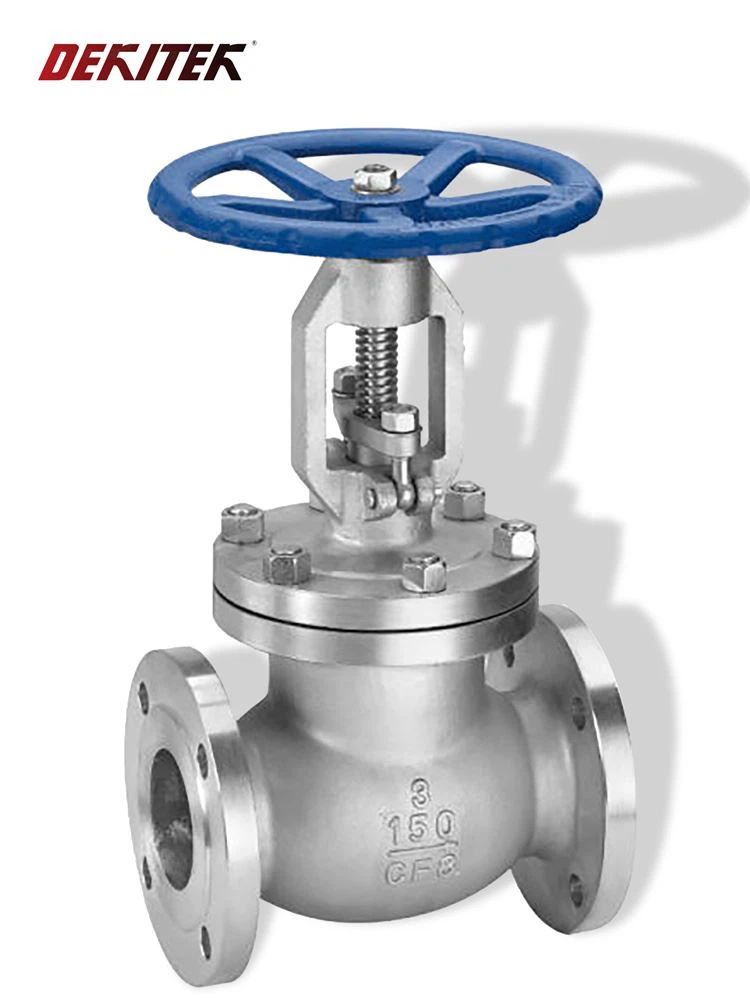
A stainless steel globe valve is a type of linear motion valve used to stop, start, and regulate flow in a pipeline. It consists of a movable disk-type element and a stationary ring seat in a generally spherical body. The operation of a globe valve involves the movement of the disc perpendicular to the seat, which causes a change in the flow area. This change in the flow area is the primary reason for the pressure drop across the valve.
The pressure drop across a valve is defined as the difference in pressure between the upstream and downstream sides of the valve when fluid is flowing through it. In the case of a stainless steel globe valve, this pressure drop is affected by several factors.
One of the main factors is the valve design. The shape and configuration of the valve's internal parts, such as the disc, seat, and body, can have a significant impact on the flow pattern and, consequently, the pressure drop. For example, a globe valve with a streamlined design will generally have a lower pressure drop compared to one with a more complex and irregular internal structure.
The flow rate of the fluid also plays a crucial role. As the flow rate increases, the pressure drop across the valve typically increases as well. This is because higher flow rates result in greater velocity and turbulence within the valve, which leads to more energy losses and a higher pressure differential.
The size of the valve is another important factor. A smaller valve with a restricted flow area will cause a higher pressure drop for a given flow rate compared to a larger valve. This is because the fluid has to pass through a smaller opening, which increases the velocity and the associated pressure losses.
The viscosity of the fluid is also relevant. More viscous fluids, such as oils, will experience a higher pressure drop across the valve compared to less viscous fluids like water. This is because viscous fluids have more internal resistance to flow, which requires more energy to overcome and results in a greater pressure differential.
To quantify the pressure drop across a stainless steel globe valve, engineers often use the concept of valve coefficient (Cv). The valve coefficient is a measure of the flow capacity of a valve and is defined as the number of US gallons of water per minute that will flow through the valve with a pressure drop of 1 psi across the valve at 60°F. A higher Cv value indicates a lower pressure drop and a higher flow capacity.
The formula for calculating the flow rate (Q) based on the valve coefficient is $Q = C_v \sqrt{\frac{\Delta P}{SG}}$, where $\Delta P$ is the pressure drop across the valve and SG is the specific gravity of the fluid. From this formula, we can rearrange to solve for the pressure drop: $\Delta P=\left(\frac{Q}{C_{v}}\right)^{2}SG$.
In practical applications, manufacturers usually provide Cv values for their valves. These values are determined through extensive testing under specific conditions. For our Stainless Steel Globe Valves, we conduct rigorous testing to accurately determine the Cv values and provide our customers with reliable information on pressure drop.
The choice of materials in the construction of the stainless steel globe valve can also indirectly affect the pressure drop. High - quality stainless steel materials are more resistant to corrosion and erosion. This means that the internal surfaces of the valve remain smooth over time, which helps maintain the original flow characteristics and reduces the potential for an increase in pressure drop due to surface roughness.
There are some common issues related to pressure drop in stainless steel globe valves. One of the issues is valve throttling. When the valve is partially open (throttled) to control the flow rate, the pressure drop can be significantly higher compared to when the valve is fully open. This is because the restricted flow area during throttling causes a large increase in fluid velocity and turbulence.
Another issue is the fouling of the valve. If the fluid contains particles or deposits, they can accumulate on the internal surfaces of the valve, reducing the flow area and increasing the pressure drop. To mitigate this problem, regular maintenance, including cleaning and inspection, is essential.
In industries such as oil and gas, chemical processing, and water treatment, accurate prediction and management of pressure drop across stainless steel globe valves are vital. In the oil and gas industry, for example, excessive pressure drop can lead to increased energy consumption and reduced efficiency in the pipeline system. In chemical processing, the pressure drop can affect the reaction kinetics and the overall performance of the process.
We also offer Duplex Steel Globe Valves, which are similar in terms of pressure drop characteristics but have enhanced corrosion resistance due to their duplex steel composition. These valves are particularly suitable for applications in harsh environments where corrosion is a major concern.
In conclusion, understanding the pressure drop across a stainless steel globe valve is essential for proper system design, operation, and maintenance. As a supplier, we are committed to providing high - quality valves and accurate technical information to our customers. If you are involved in any project where stainless steel globe valves are required, or you want to learn more about pressure drop and valve selection, we are here to assist you. Our team of experts can provide personalized advice based on your specific application requirements. Don't hesitate to contact us for any further details or to start a procurement discussion. We look forward to working with you to ensure the optimal performance of your piping systems.
References
- M. W. Kellogg, "Conceptual and Preliminary Design of Chemical Processes", John Wiley & Sons.
- Idelchik, I. E., "Handbook of Hydraulic Resistance", Begell House.