



Hey there! As a supplier of butterfly valves, I've spent a ton of time diving into how these nifty devices work. One question that often pops up is: How does the angle of the disc affect the flow in a butterfly valve? Well, let's dig into it.

First off, let's quickly go over what a butterfly valve is. It's a type of valve that uses a disk - shaped element to control the flow of fluid through a pipe. The disk rotates around an axis, and depending on its position, it either allows the fluid to pass or restricts its flow. The angle of this disc is crucial as it directly impacts the flow characteristics.
When the disc is fully open, which means it's at a 90 - degree angle relative to the pipe wall, the flow area is maximized. In this position, the valve offers the least resistance to the fluid flow. The fluid can pass through the valve with minimal obstruction, much like water flowing freely through an open channel. This is ideal for applications where you need a high flow rate, such as in large - scale water distribution systems or some industrial processes where a large volume of fluid needs to be moved quickly.
Now, as we start to close the valve by changing the disc angle, things get a bit more interesting. As the disc rotates towards a closed position, the flow area gradually decreases. This reduction in the flow area causes an increase in the fluid velocity. According to the principle of conservation of mass (you know, the whole mass in equals mass out thing), when the cross - sectional area through which the fluid is flowing decreases, the fluid has to speed up to maintain the same mass flow rate.
But here's the catch. With the increase in fluid velocity comes an increase in pressure drop across the valve. Pressure drop is basically the difference in pressure between the inlet and the outlet of the valve. A higher pressure drop means that more energy is required to push the fluid through the valve. In a real - world scenario, this could mean higher operating costs for pumps or compressors that are used to move the fluid.
When the disc angle is around 45 degrees, the valve is in a partially open state. At this angle, the flow is a bit more complex. The fluid has to navigate around the disc, which creates turbulence. Turbulence is when the fluid flow becomes chaotic, with eddies and swirls forming. This turbulence can cause additional energy losses and can also lead to wear and tear on the valve components over time.
As the disc approaches a fully closed position (0 - degree angle), the flow area becomes extremely small. The fluid has to squeeze through a tiny gap, and the pressure drop across the valve becomes very high. In fact, in a well - designed butterfly valve, when the disc is fully closed, it should create a tight seal to prevent any leakage. However, achieving a perfect seal can be challenging, especially in applications where there are high - pressure differentials or where the fluid contains abrasive particles.
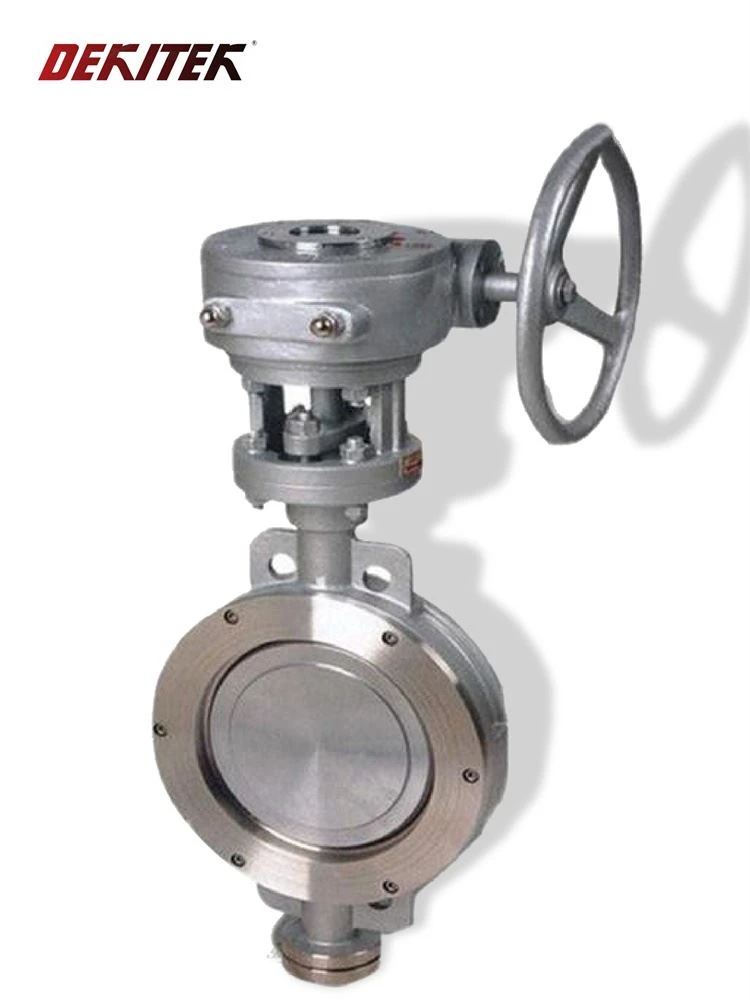
Let's talk about some of the different types of butterfly valves we offer. We have the Triple Offset Wafer Type Butterfly Valve. This valve is designed with three offsets, which gives it a unique sealing mechanism. The triple - offset design allows for a more precise control of the disc angle, which in turn can lead to better flow control. It's great for applications where you need a high - performance valve that can handle high - pressure and high - temperature conditions.
Another option is the BW Type Metal Sealing Butterfly Valve. This valve uses a metal seal, which provides excellent durability and resistance to corrosion. The metal seal can maintain a good seal even at different disc angles, making it suitable for a wide range of applications, from chemical processing to power generation.
We also have the Double Offset Wafer Type Butterfly Valve. The double - offset design reduces the friction between the disc and the seat, which makes the valve easier to operate. It can also provide a better flow control at various disc angles compared to a single - offset valve.
So, why does all this matter? Well, understanding how the disc angle affects the flow in a butterfly valve is crucial for choosing the right valve for your application. If you need a valve for a high - flow, low - pressure - drop application, you'll want to keep the disc angle close to 90 degrees most of the time. On the other hand, if you need precise flow control, you might need a valve that can operate effectively at different disc angles.
If you're in the market for a butterfly valve, whether it's for a new project or to replace an existing valve, we're here to help. We've got a wide range of valves to suit different needs and budgets. Our team of experts can work with you to understand your specific requirements and recommend the best valve for your application.
Don't hesitate to reach out if you have any questions or if you're ready to start a procurement discussion. We're looking forward to working with you to find the perfect butterfly valve solution for your needs.
References
- "Valve Handbook: A Guide to Selection, Specification, and Installation" by Valve Manufacturers Association of America
- "Fluid Mechanics" by Frank M. White