

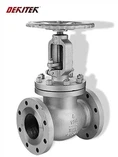
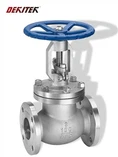
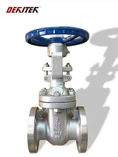
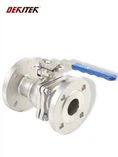
The truncant valve refers to the valve of the closure (valve) along the center line of the valve seat. It mainly plays a cutting effect on the pipeline.
The use of the truncant valve is extremely common, but because the torque is large and the mechanism is long, the mechanism is relatively long. Generally, the nominal size is limited to DN250. In addition, the nominal diameter of the cut -off valve is also related to work pressure.
The obvious advantages of the cut -off valve are as follows: | | |
1. During the opening and closing process, because the friction between the valve petals and the dense cover of the valve body is smaller than the valve, it is worn.
2. The height is much smaller than the gate valve.
3. Usually there is only one seal on the valve body and valve petals, so the manufacturing process is better to facilitate maintenance.
However, the disadvantages of the cut -off valve cannot be ignored. The disadvantage is mainly caused by the form of the body cavity. In the body cavity, the medium changes from the straight line to the upward flow, which causes stress loss, especially in the hydraulic device. This pressure loss is particularly obvious.
There are many types of trial valves. Generally, classification is generally classified according to the location, channel form, and valve flap shape of the thread on the valve stem. It can be divided into::
1. Tripstarial valve of the thread valve stem
The application of this cut -off valve is more common. Its valve stem thread is outside the shell and does not directly contact the working medium. This can make the valve stems from being eroded by the medium, and it is also convenient for lubrication and saving effort, as shown in Figure 2-38.
2. Sub -thread valve stem triability valve
The valve stem thread of this truncation valve is in the valve body and is directly contacting the medium.
The interception valve of this institution is mostly used in places where the nominal size is relatively small and the medium work temperature is not high.
3. Direct interception valve
The two channels of the medium in the same direction are 180 °, as shown in Figures 2-38 and Figure 2-39. This form of cut -off valve makes the destruction of the flow state relatively small, so the pressure loss of the valve has also been reduced accordingly.
4. Corner interception valve
The imported channels of the corner cut-off valve are 90 ° real angles in the same direction, as shown in Figure 2-40. This form of truncation valve changes the flow direction through the medium of the valve, so it will cause a certain amount of pressure. The great advantage of the corner cut -off valve is that the valve can be installed at the corner of the pipe system, which not only saves 90 ° elbow and is easy to operate. This type of valve is used in synthetic ammonia production systems and refrigeration systems in chemical fertilizers.
5. Trinity triability valve
It has three channels for cut -off valve, which is usually used to change the direction of the medium flow and the distribution medium
6. DC intercept valve
The valve stems and channels of the DC truncation valve are in one angle, and the cover of the valve seat and the imported channel at a certain angle; the valve body can be made into an overall formula, or the composition can be opened, as shown in Figure 2-42. The separated valve of the valve body uses the two valve to clamp the valve seat in the middle, which is easy to manufacture and repair. This type of cut -off valve makes the fluid almost unchanged in the flow direction, which is less in the interdependent valve. The installation method is divided into a direct way, but it should be paid special attention to the operation after the pipeline is installed.
7. Insidation valve
The plunger cut -off valve is the deformation of the conventional interception valve. In the plunger -style intercept valve, its valve petals and valve seats are designed according to the principle of the plunger; the valve petals are designed as a plunger valve, the valve seat design is set, and the coordination of the plunger valve and the ring is sealed. This valve manufacturing is simple, and the ring can be made of graphite and polytimonia ethylene; good sealing, high and low temperature medium can be used. The valve is mainly enabled and closed, but the plunger and case designed as a special form can also be used for flow adjustment.
8. Needle -shaped trips
The needle -shaped truncorated valve is used as accurate flow control. It is usually limited to small caliber. Generally, the size of the valve seat hole is smaller than the nominal size