



Hey there! As a supplier of Pneumatic Actuator Gate Valves, I often get asked about what control systems can be used with these valves. So, I thought I'd write this blog to share some insights on the topic.
First off, let's understand what a pneumatic actuator gate valve is. It's a type of valve that uses compressed air to operate the gate, which is the part that controls the flow of fluid through the valve. These valves are commonly used in industrial applications where quick and reliable shut-off is required.
Now, let's dive into the control systems that can be used with pneumatic actuator gate valves.
1. On - Off Control Systems
The simplest type of control system for a pneumatic actuator gate valve is an on - off control system. In this system, the valve is either fully open or fully closed. It's like a light switch - you turn it on, and the valve opens; you turn it off, and the valve closes.
This type of control is great for applications where you just need to start or stop the flow of fluid. For example, in a water treatment plant, you might use an on - off control system to start or stop the flow of water into a treatment tank.
To implement an on - off control system, you typically use a solenoid valve. The solenoid valve controls the flow of compressed air to the pneumatic actuator. When the solenoid is energized, it allows compressed air to flow to the actuator, which opens the valve. When the solenoid is de - energized, the compressed air is vented, and the valve closes.
2. Proportional Control Systems
Proportional control systems are a step up from on - off control systems. In a proportional control system, the valve can be positioned at any point between fully open and fully closed. This allows for more precise control of the flow rate.
Let's say you're in a chemical processing plant, and you need to control the flow of a chemical into a reaction vessel. You can't just open or close the valve; you need to be able to adjust the flow rate precisely. That's where a proportional control system comes in handy.
To achieve proportional control, you use a positioner. The positioner receives a control signal (usually an electrical signal, like a 4 - 20 mA signal) and adjusts the position of the valve accordingly. The positioner compares the actual position of the valve (measured by a position sensor) with the desired position (set by the control signal) and makes adjustments to the flow of compressed air to the actuator to move the valve to the correct position.
3. Programmable Logic Controller (PLC) - Based Control Systems
PLC - based control systems are very versatile and are widely used in industrial applications. A PLC is a computer - based controller that can be programmed to perform a variety of control functions.

With a PLC - based control system, you can implement complex control strategies. For example, you can program the PLC to open the valve at a certain time of day, or to adjust the valve position based on the temperature or pressure of the fluid.
The PLC communicates with the pneumatic actuator gate valve through input/output (I/O) modules. The I/O modules receive signals from sensors (like pressure sensors, temperature sensors, etc.) and send control signals to the solenoid valves or positioners that control the valve.
4. Distributed Control Systems (DCS)
Distributed Control Systems are used in large - scale industrial applications where there are multiple valves and other control devices that need to be coordinated. A DCS consists of multiple controllers that are distributed throughout the plant and are connected by a communication network.
In a DCS, each controller can be responsible for controlling a group of valves or other devices. The controllers can communicate with each other and with a central control station. This allows for centralized monitoring and control of the entire process.
For example, in a large oil refinery, a DCS can be used to control the flow of oil through multiple pipelines, tanks, and processing units. The DCS can ensure that the flow rates are optimized, and that the entire refinery operates efficiently.
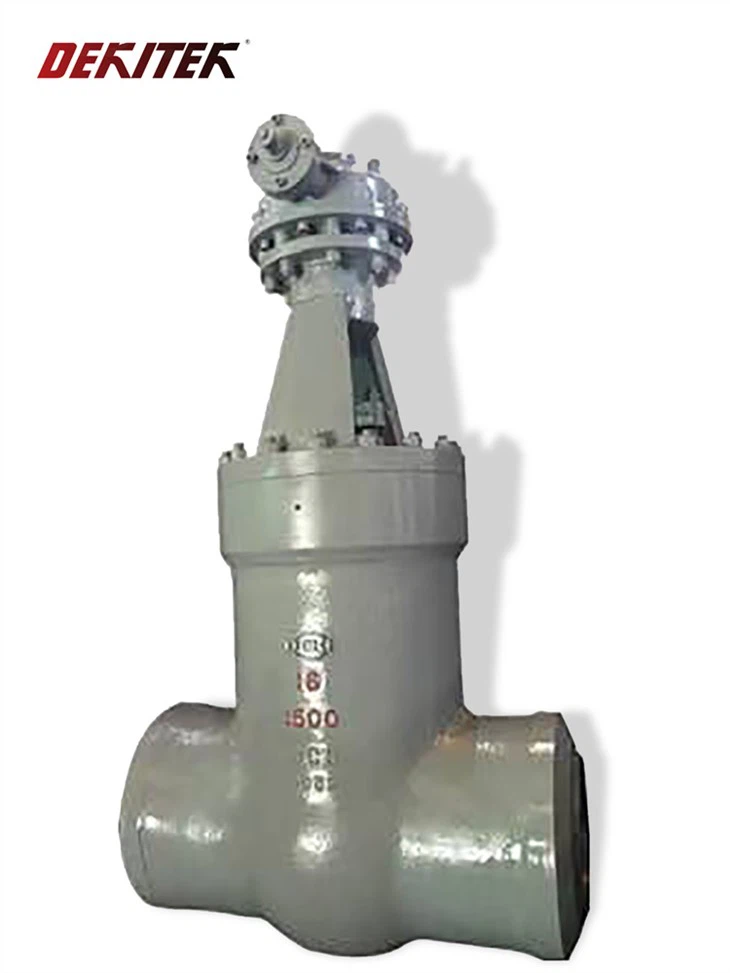
Now, I'd like to mention some of the products we offer as a Pneumatic Actuator Gate Valve supplier. We have a wide range of gate valves, including Stainless Steel Pressure Seal Gate Valve, Alloy Steel Pressure Seal Gate Valve, and Duplex Stainless Steel Gate Valve. These valves are made of high - quality materials and are designed to work well with different control systems.
If you're in the market for a pneumatic actuator gate valve and need help choosing the right control system, don't hesitate to reach out. We have a team of experts who can guide you through the selection process and ensure that you get the best solution for your application. Whether you need a simple on - off control system or a complex DCS, we've got you covered.
So, if you're interested in learning more or making a purchase, just get in touch with us. We're here to help you find the perfect valve and control system for your specific needs.
References
- "Industrial Valves Handbook" by William A. Nayfeh
- "Control Systems Engineering" by Norman S. Nise