



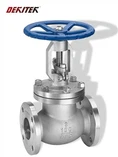

Duplex steel globe valves are indispensable components in many industrial applications, known for their excellent corrosion resistance, high strength, and durability. These valves are versatile, and one of the key aspects that contribute to their versatility is the variety of end connections available. As a supplier of Duplex Steel Globe Valve, I understand the importance of choosing the right end connection for different applications. In this blog, we will explore the different types of end connections for a duplex steel globe valve.
Threaded End Connections
Threaded end connections are one of the most common types of end connections for duplex steel globe valves. They are easy to install and are suitable for small - sized valves and low - pressure applications. The threads can be either male or female. Male threaded ends are external threads that screw into a female - threaded fitting, while female threaded ends have internal threads that accept a male - threaded pipe or fitting.
The advantage of threaded end connections is their simplicity. They do not require any special welding equipment or skills for installation. However, they also have limitations. Threaded connections are not suitable for high - pressure or high - temperature applications because the threads can loosen over time due to vibration and thermal expansion. Additionally, they have a relatively limited sealing ability compared to other types of connections, which may lead to leakage in critical applications.
Flanged End Connections
Flanged end connections are widely used in industrial settings and are suitable for medium - to high - pressure applications. A flanged valve has a flange at each end, which is bolted to a corresponding flange on the pipeline. Flanged connections provide a strong and reliable seal, making them suitable for applications where leakage prevention is crucial.
There are different types of flanges, such as weld - neck flanges, slip - on flanges, socket - weld flanges, and blind flanges. Weld - neck flanges are the most common type used with globe valves. They are welded to the valve body and the pipeline, providing a strong connection. Slip - on flanges are easier to install as they slide over the pipe and are then welded in place. Socket - weld flanges are used for smaller pipe sizes and are also welded to provide a leak - tight connection.
The main advantage of flanged end connections is their high strength and reliability. They can withstand high pressures and temperatures without the risk of leakage. However, the installation of flanged connections is more complex and time - consuming compared to threaded connections. It requires proper alignment and tightening of bolts to ensure a proper seal.
Welded End Connections
Welded end connections offer the highest level of integrity and are suitable for high - pressure, high - temperature, and critical applications. There are two main types of welded end connections: butt - weld and socket - weld.
Butt - weld connections involve joining the valve body directly to the pipeline by welding the ends of the valve and the pipe together. This type of connection provides a continuous flow path with minimal turbulence and is ideal for applications where fluid flow efficiency is important. Socket - weld connections, on the other hand, involve inserting the pipe into a socket in the valve body and then welding around the joint. Socket - weld connections are commonly used for smaller pipe sizes.
The advantage of welded end connections is their excellent sealing ability and structural integrity. They eliminate the need for gaskets or other sealing materials, reducing the risk of leakage. However, welded connections are permanent, which means that if the valve needs to be replaced or repaired, the welding must be cut, and new welding must be done, which can be time - consuming and costly.
Socket - Weld End Connections
Socket - weld end connections are a specific type of welded connection. They are commonly used for small - diameter pipes (usually up to 4 inches) in industrial applications. The pipe is inserted into a socket in the valve body, and then a fillet weld is applied around the joint.
Socket - weld connections are relatively easy to install compared to butt - weld connections. They require less preparation and alignment, and the welding process is simpler. They also provide a good seal and are suitable for applications where space is limited. However, socket - weld connections may have some limitations. The fillet weld can introduce some turbulence in the fluid flow, and the internal surface of the socket can trap debris, which may affect the performance of the valve.
Ring - Type Joint Flange End Connections
Ring - type joint flange end connections are designed for high - pressure and high - temperature applications, especially in the oil and gas industry. These connections use a metallic ring gasket that is placed in a groove in the flange faces. When the flanges are bolted together, the ring gasket is compressed, creating a metal - to - metal seal.
The advantage of ring - type joint flange end connections is their excellent sealing performance under extreme conditions. They can withstand very high pressures and temperatures without leakage. However, they are more expensive than other types of flanged connections, and the installation requires precise machining of the flange faces and proper selection of the ring gasket.


Selecting the Right End Connection
When choosing the appropriate end connection for a duplex steel globe valve, several factors need to be considered. The first factor is the operating pressure and temperature of the application. High - pressure and high - temperature applications usually require flanged or welded end connections, while low - pressure and low - temperature applications may be suitable for threaded or socket - weld connections.
The size of the pipeline is also an important consideration. Smaller pipe sizes may be more suitable for threaded or socket - weld connections, while larger pipe sizes typically require flanged or butt - weld connections.
The type of fluid being transported is another factor. Corrosive or toxic fluids may require a more reliable and leak - proof connection, such as a welded or flanged connection with a proper gasket material.
Finally, the installation and maintenance requirements should also be taken into account. If the valve needs to be frequently replaced or repaired, a connection that is easy to install and disassemble, such as a flanged connection, may be more appropriate.
As a supplier of Duplex Steel Globe Valve, we can provide professional advice on choosing the right end connection for your specific application. We also offer a wide range of Alloy Steel Globe Valve and Alloy Steel Globe Valve with different end connections to meet your diverse needs.
If you are interested in our products or need more information about duplex steel globe valves and their end connections, please feel free to contact us for procurement and further discussions. We are committed to providing you with high - quality products and excellent service.
References
- Valve Handbook, Crane Co.
- Standards for Piping Components, ASME (American Society of Mechanical Engineers)