


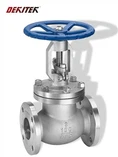

Hey there! As a check valve supplier, I often get asked about how these nifty devices work, especially the stop check valve. So, I thought I'd take a moment to break it down for you in plain English.
First off, let's talk about what a check valve is in general. A check valve is a type of valve that allows fluid to flow in one direction only. It's like a one - way street for your plumbing or piping system. This is super important because it prevents backflow, which can cause all sorts of problems, like contamination of your clean water supply or damage to pumps and other equipment.
Now, a stop check valve takes this basic concept a step further. It not only allows fluid to flow in one direction but also has the ability to stop the flow completely when needed. It's like having a traffic cop on your one - way street who can close it down whenever necessary.
How Does It Work?
The working principle of a stop check valve is based on a few key components. The main parts include the valve body, the disc, the seat, and the actuator.
The valve body is the outer casing that houses all the other parts. It's usually made of materials like cast iron, stainless steel, or brass, depending on the application and the type of fluid it will be handling.
The disc is the moving part inside the valve. It's designed to open when the fluid is flowing in the correct direction and close when the flow tries to reverse. In a stop check valve, the disc can also be held in a closed position by the actuator.
The seat is the surface where the disc rests when the valve is closed. It forms a tight seal to prevent any leakage. A well - designed seat is crucial for the proper functioning of the valve.
The actuator is what gives the stop check valve its "stop" function. It can be a manual handwheel, an electric motor, a pneumatic cylinder, or a hydraulic piston. When you want to stop the flow, you use the actuator to move the disc into the closed position and hold it there.
Let's go through the operation in more detail. When the fluid pressure on the inlet side of the valve is higher than the pressure on the outlet side, the disc is pushed open. This allows the fluid to flow through the valve in the desired direction. The disc is designed in such a way that it offers minimal resistance to the flow when it's open, so there's not much pressure drop across the valve.


However, if the pressure on the outlet side starts to rise and becomes higher than the inlet pressure, the disc will automatically close. This is due to the pressure difference and the weight of the disc itself. In some cases, there might also be a spring to assist the closing action.
Now, when you need to stop the flow intentionally, you use the actuator. For example, if you're doing maintenance on a pipeline and you don't want any fluid to pass through the valve, you can turn the handwheel on a manually - operated actuator. This will move the disc down onto the seat and create a tight seal. Even if there's pressure on the inlet side, the actuator will hold the disc in place, preventing any flow.
Types of Stop Check Valves
There are a few different types of stop check valves, each with its own advantages and applications.
One common type is the swing - type stop check valve. In a swing - type valve, the disc is hinged at the top. When the fluid flows in the correct direction, the disc swings open like a door. When the flow reverses, it swings back shut. The API6D Flange End Swing Type Check Valve is a great example of this type. It's often used in large - diameter pipelines and applications where a relatively low - pressure drop is required.
Another type is the lift - type stop check valve. In a lift - type valve, the disc moves up and down in a straight line to open and close. This type of valve is known for its quick - closing action, which makes it suitable for applications where rapid shut - off is needed to prevent water hammer. The API 6D BW Check Valve is a variant that can be used in high - pressure and high - temperature applications.
Applications
Stop check valves are used in a wide range of industries. In the oil and gas industry, they're used in pipelines to prevent backflow and to isolate sections of the pipeline during maintenance. In power plants, they're used in steam and water systems to control the flow and protect equipment from damage. In the water treatment industry, they're used to prevent contamination of the clean water supply.
Why Choose Our Check Valves?
As a check valve supplier, we take pride in offering high - quality products. Our stop check valves are designed and manufactured to the highest standards. We use top - notch materials and advanced manufacturing techniques to ensure that our valves are durable, reliable, and efficient.
We also offer a wide range of options to meet different customer needs. Whether you need a small - sized valve for a residential application or a large - scale valve for an industrial project, we've got you covered. Our technical team is always on hand to provide you with expert advice and support.
If you're in the market for a stop check valve or any other type of check valve, we'd love to hear from you. We can provide you with detailed product information, competitive pricing, and fast delivery. Just reach out to us, and we'll work with you to find the perfect solution for your needs.
Conclusion
In conclusion, a stop check valve is a vital component in many fluid - handling systems. Its ability to allow one - way flow and stop the flow when necessary makes it a versatile and essential device. Whether you're dealing with water, steam, oil, or any other type of fluid, a well - designed stop check valve can help keep your system running smoothly and safely.
So, if you're looking for a reliable check valve supplier, look no further. We're here to provide you with the best products and services in the industry. Contact us today to start the conversation about your check valve needs, and let's work together to find the right solution for you.
References
- "Valve Handbook" by J. Paikert
- "Fluid Mechanics and Hydraulic Machines" by R. K. Bansal