

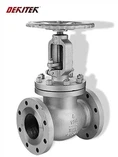
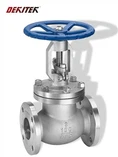
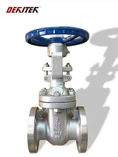
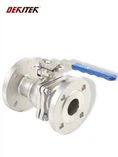
steel globe valves play a crucial role in industry. It is widely used in petroleum, chemical, electric power and pharmaceutical industries to control fluid flow and switch accurately. Its performance directly affects the efficiency and safety of the whole industrial system. Corrosion resistance, as an important performance indicator of stainless steel cut-off valve, has a decisive impact on its service life and reliability. Once the valve corrodes, it will not only lead to media leakage and affect the normal operation of the production process, but also cause safety accidents and huge economic losses. Therefore, it is of great significance to study the factors affecting the corrosion resistance of stainless steel cut-off valve in order to improve its quality and ensure the safety of industrial production.
Effect of Influence of Stainless Steel Globe Valve Material Composition on Corrosion Resistance
Chromium
Chromium is one of the most important alloy elements in stainless steel. In stainless steel cut-off valves, chromium forms a dense passivation film on the metal surface. The main component of this passivation film is chromium oxide, which has high stability and chemical inertness. It can effectively isolate the metal matrix from external corrosive medium and prevent further corrosion reactions.
The results show that chromium content is closely related to the stability of the passivation film. In general, a stable and continuous passivation film are formed only when the chromium content in stainless steel exceeds 12%. With the increase the chromium content, the thickness and density of the passivation film also increase, and its corrosion resistance increases obviously. In common industrial atmospheres, for example, 316 stainless steel with a higher chromium content is more corrosion resistance, rusts later and rusts less than 304 stainless steel with a lower chromium content.
Nickel role
Nickel plays an important role in the crystal structure of stainless steel. It stabilizes the austenite structure and allows stainless steel to remain an austenitic state at room temperature. This stable austenite structure provides a good basis for the formation of the passivation film and also improves the stability of the passivation film.
Nickel plays an important role in the environment of weak acidic medium. For example, in a solution containing a small amount of acetic acid, stainless steel containing nickel can quickly form a uniform and dense passivation film, effectively preventing acetic acid from corroding the metal matrix. Nickel-free stainless steel is prone to spot corrosion in this environment, resulting in local corrosion pits on the valve surface of the valve, affecting sealing performance and service life. Taking 304 stainless steel and 316 stainless steel as examples, 316 stainless steel contains a certain amount of nickel and has better corrosion resistance than 304 stainless steel in weakly acidic environment.
Molybdenum
Molybdenum plays an important role in improving corrosion resistance of stainless steel and reducing chlorine-containing acid and environment. Molybdenum can promote the repair and regeneration of passivated the passivation film a reductive acid environments (e.g. sulfuric acid acid, hydrochloric acid, etc.), and restore the integrity and stability the passivation film quickly after being attacked by corrosive media.
In the environment containing chloride ions (such as marine environment, salt spray environments, etc.), chloride ions can easily adsorb to metal surface, destroy the passivation film and cause spot erosion. Molybdenum can change the composition and structure of the passivation membrane and make the passivation membrane more resistant to chlorine ion. Comparing the useful life of molybdenum-containing stainless steel and molybdenum-containing and molybdenum-free stainless steel in marine environment, it can be found that molybdenum-containing stainless steel steel (e.g., 316L stainless steel) can operate stably in marine environment for a long period of several decades, while molybdenum-free stainless steel (e.g., 304 stainless steel) is prone to serious corrosion problems in marine environment, often for only a few years.
Role of other elements
Besides chromium, nickel, molybdenum, carbon, titanium, niobium and so on have certain influence on corrosion resistance of stainless steel. Carbon is one of the harmful elements in stainless steel. When the carbon content is too high, under high temperature or certain environment, carbon and chromium combine to form chromium carbide, which leads to grain boundaries loss of chromium in grain boundary, which reduces the corrosion resistance of grain boundary and causes intergranular corrosion.
Titanium and niobium have stabilizing properties. They can preferentially bind to carbon to form stable carbides, preventing carbon from binding to chromium to form chromium carbide, thus avoiding intergranular corrosion. For example, 321 stainless steel have titanium added and 347 stainless steel have niobium added. These two stainless steels have good intergranular corrosion resistance at high temperature and are widely used in chemical and electric industries.
Effect of Environmental Factors on Corrosion Resistance of Stainless Steel Interceptor Valve
Atmospheric environment
chloride content varies greatly in different atmospheric environments, which has a great impact on the corrosion resistance of stainless steel cut-off valves. chloride content rural atmosphere is relatively low and weaker corrosivity, so stainless steel cut-off valve can maintain good corrosion resistance in this environment for a long time. Industrial atmosphere contains a large amount of industrial exhaust gas and dust, which may contain a certain amount of chloride and other corrosive substances, leading to relatively strong corrosivity. chloride content highest in the marine atmosphere; sea salt particles are carried into the air by sea breezes and attach to the surface of the valve, forming electrolyte solution in humid conditions that accelerate valve corrosion.
For example, in coastal chemical enterprises, stainless steel cut-off valves are prone to rust due to prolonged exposure to the ocean atmosphere and require regular maintenance and replacement. steel globe valves have a relatively long service life in similar enterprises in the interior. Different types of stainless steel also exhibit different corrosion resistance performance in different atmospheric environments. Because 316L 316L stainless steel high in chromium, nickel and molybdenum content, it has better corrosion resistance in ocean atmosphere, while 304 stainless steel has relatively poor corrosion resistance in ocean atmosphere.
Water environment
Freshwater
Freshwater can be divided into scaling water and non-scaling water. Scaling water contains a lot of calcium and magnesium ions, which can be scale deposits easily in the inner wall of valve during heating or evaporation. The presence of scale affects heat transfer efficiency and provides a hiding place for corrosive media, which accelerates valve corrosion. The content of Non-scaling water is low and the corrosion is relatively small. The corrosion resistance of stainless steel cut-off valve in freshwater mainly depends on the purity and oxygen content of water. In general, the purer the water and the lower the oxygen content, the less corrosive the valve.
Acidic Water
Acidic water is mainly formed by wastewater discharge and mine drainage. Acidic water is highly corrosive and can react with metals, leading to valve corrosion. Austenitic stainless steel has good corrosion resistance advantage in acidic water. This is because the crystal structure of austenitic stainless steel is stable, the passivation film is dense and can resist the erosion of acidic medium effectively. For example, in industrial wastewater containing a small amount of sulfuric acid, 316L stainless steel globe valves can operate steadily for a long time, whereas conventional carbon steel valves are prone to corrosion and perforation.
Saline Water
Saline water contains a large amount of chloride ions, easily adsorbed on the metal surface, damaging the passivation film, causing spot erosion. Pitting corrosion is a local corrosion phenomenon. Although the corroded area small, but the corrosion depth is large, easy to lead to valve leakage. In order to reduce the corrosion caused by saline water, the valve can be designed by increasing the thickness of the valve wall thickness and choosing stainless steel material with good corrosion resistance. For example, stainless steel cut-off valves on offshore platforms typically use materials with excellent corrosion resistance, such as 316L stainless steel or dual-phase stainless steel.
Soil environment
Soil corrosion is a complex process, which is influenced by soil moisture, pH, salinity and microorganism. Different types of soil exhibit have obvious differences in their corrosiveness of stainless steel cut-off valve. For example, acidic and salt content soils are more corrosive, while neutral and low-salinity soils are less corrosive.
austenitic stainless steel and certain grades of stainless steel also have different corrosion resistance in soil environments. In general 316L stainless steel is good corrosion resistance in most soil environments, but corrosion can still occur in some highly corrosive soils. Due to the structure of austenite and ferrite, biphase stainless steel has excellent comprehensive properties and corrosion resistance in soil corrosion environment.
Chemical Media Environment
In chemical and pharmaceutical industries, stainless steel cut-off valves are frequently exposed to various chemical media such as nitric acid, sulphuric acid, phosphoric acid and hydrochloric acid. Different chemical media have different The corrosiveness to stainless steel, and different chemical media have different corrosion resistance and suitable materials for stainless steel cut-off valve.
nitric acid, for example, is a strong oxidizing acid that is relatively low corrosiveness to stainless steel, most of which can be used in nitric acid environments. However, the corrosiveness of concentrated nitric acid to stainless steel increases with temperature, which requires the selection of stainless steel materials with high alloy content. Sulfuric acid is a high corrosiveness reductive acid to stainless steel, and only some stainless steel can be used to dilute sulfuric acid at low temperatures. In concentrated sulfuric acid environments, molybdenum-containing stainless steel or high-silicon stainless steel usually required. Phosphoric acid is relatively less corrosive, most stainless steel can be used in phosphoric acid environments, but in high temperature, high concentration of phosphoric acid environment, still need better corrosion resistance materials. Hydrochloric acid is a kind of strong reductive acid, which is very corrosive to stainless steel. Ordinary stainless steel is easily corroded in the environment of hydrochloric acid environments.
Effect of operating conditions on the Corrosion Resistance of Stainless Steel Globe Valves
Temperature
Increasing temperature will accelerate the chemical reactions speed and affect the stability of the passivation film. In high temperature environment, the activity of corrosive medium increases, the reaction rate with metal accelerates, easy to lead to valve corrosion. At the same time, high temperature will cause the structure of passivation film to change, reducing the stability and protective performance of the passivation film.
For example, in a high temperature vapor environment, the surface passivation film of a stainless steel cut-off valve is easily damaged, leading to corrosion. Different types of stainless steel have different corrosion resistance at different temperatures. 304 Stainless steel has poor corrosion resistance in high temperature environment and is prone to intergranular corrosion and better σ-phase embrittlement when the temperature exceeds 450 ℃. However, 316L stainless steel has significantly better corrosion resistance than 304 stainless steel due to its molybdenum content, and can operate steadily below 600 ° C for a long period of time.
Stress
Pressure has an important effect on the flow state and erosive force of media. In high pressure environment, the flow rate of medium increases, the erosive force increases, easy to cause erosion corrosion of valve inner wall. At the same time, high pressure can also improve the permeability of the medium, so that the medium is easier to penetrate into the valve's small cracks, causing crevice corrosion.
For example, in high-pressure pipelines, stainless steel cut-off valves are subject to high pressure and media erosion and require high corrosion resistance and mechanical properties. In order to meet the requirements of high pressure working conditions, high strength and corrosion resistant stainless steel materials are often used, and special structural designs such as increasing valve wall thickness and optimizing flow path shape are adopted to improve the corrosion resistance of valves.
Medium Flow Velocity
Dielectric flow velocity has a great influence on erosion corrosion. When the medium flow velocity is too high, it will cause strong corrosion to the inner wall of the valve, accelerating the wear and corrosion of metal materials. Especially in the valve inlet and outlet, bending head, the dielectric flow velocity changes is obvious, easy to form turbulence, aggravates the erosion corrosion degree.
In order to reduce erosion corrosion, a series of measures need to be taken in the design of runways. For example, optimize the shape of the flow path to make fluid flow smoother and reduce turbulence; increase the surface roughness the inner wall of the valve to form oxide film; and select stainless steel materials with higher hardness and wear resistance. For example, in some high-speed fluid delivery systems, the use of piped valves can effectively reduce fluid velocity and erosive force and prolong valve service life.
Valve Structure and Sealing
Sealing Structure
The valve disc and seat seal, and the packing seal, are crucial components in preventing media leakage and corrosion. A good sealing structure effectively prevents corrosive media from entering the valve interior, reducing internal corrosion. The selection of sealing materials is also very important, requiring the selection of appropriate materials based on factors such as the nature of the medium, temperature, and pressure.
For example, in high-temperature and high-pressure chemical environments, high-temperature and corrosion-resistant sealing materials such as polytetrafluoroethylene and flexible graphite are typically used. In industries with high hygiene requirements, such as food and pharmaceuticals, sealing materials that meet hygiene standards, such as silicone rubber, are required. Regular inspection and replacement of sealing components are also necessary to ensure good sealing performance.
Flow Channel Design
Flow channel design has a significant impact on the flow state of the medium and internal wall erosion and corrosion. A reasonable flow channel design allows for uniform media flow, reduces turbulence and dead zones, and lowers the degree of erosion and corrosion. For example, a full-bore valve flow channel design allows for smooth media flow, reducing the residence time of the medium within the valve and lowering the risk of corrosion. Furthermore, the flow state of the medium can be further improved, and the corrosion resistance of the valve enhanced, by incorporating guide plates and buffer devices within the flow channel.
Conclusion:
In conclusion, the corrosion resistance of stainless steel cut-off valve is influenced by a combination of material composition, environmental factors and operating conditions. Chromium, nickel and molybdenum are the key factors that determine the corrosion resistance of stainless steel. The content and combination of these elements directly affect the formation and stability of the passivation film. Environmental factors such as atmosphere, water, soil and chemical media environments contain different corrosive substances, which leads to different types and degrees of corrosion of valves. Temperature, pressure, media flow rate, valve structure and sealing conditions also have an important impact on the corrosion resistance of valves.
In practice, in order to give full play to the corrosion resistance advantages of stainless steel cut-off valve and ensure its long-term stable operation, suitable materials need to be selected according to specific conditions of use. For example, stainless steel materials containing molybdenum should be used in marine environment or in environments with high concentrations of chloride ion concentrations, and high-strength, high-temperature resistant stainless steel materials should be selected under high temperature and pressure conditions. At the same time, optimization valve design, reasonable design of flow channel structure, selection of appropriate sealing materials, is also the key to reduce the risk of erosion corrosion and media leakage. In addition, regular maintenance and upkeep of valves, including timely replacement of damaged parts, is an important measure to ensure corrosion resistance and service life of valves.