

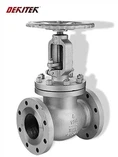
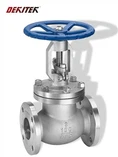
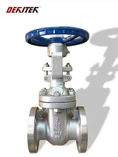
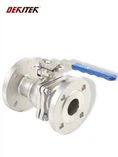
When installing the valve, in order to prevent foreign matter such as sand from entering the valve and damaging the sealing surface, a filter and a flushing valve need to be installed before the valve; in order to maintain compressed air and purified air, an oil-water separator or an air filter needs to be installed before the valve; in order to check the working status of the valve during operation, instruments and check valves need to be installed; in order to maintain the temperature when operating the valve, insulation facilities are installed outside the valve; for installation after the valve, a safety valve or a check valve needs to be installed; considering the continuous operation of the valve, it is convenient to be dangerous, so a parallel system or a bypass system is set up.
1. Protection measures for check valves: In order to prevent the check valve from leaking or failing, the medium flows back, thereby causing the quality of the product to decline and causing serious accidents, we need to set one or two cut-off valves before and after the check valve. If two cut-off valves are set, the check valve can be easily disassembled for maintenance.
2. Protection measures for safety valves: Generally, a cut-off valve is not set before and after the installation method, and it can only be used in extremely rare cases. If the medium contains solid particles, which affects the safety valve from being closed after it is tripped, a gate valve with a lead seal should be installed before and after the safety valve. The gate valve should be in a fully open state. The gate valves and safety valves produced by Shanghai Guanhuan Valve Manufacturing Co., Ltd. are directly equipped with a DN20 inspection valve to the atmosphere. When the wax and other media to be discharged are solid at room temperature, or when the temperature of light liquid and other media is lower than 0 degrees Celsius due to reduced pressure and gasification, the safety valve needs steam heating. For safety valves used for corrosive media, consider adding a corrosion-resistant explosion-proof membrane at the valve inlet depending on the corrosion resistance of the valve. A gas safety valve is generally equipped with a bypass valve according to its diameter for manual venting.
3. Protection measures for pressure reducing valves: There are generally three forms of pressure reducing valve installation facilities. Pressure gauges are installed before and after the pressure reducing valve to facilitate observation of the pressure before and after the valve. In addition, a fully enclosed safety valve is installed after the valve to prevent the pressure after the pressure reducing valve fails and exceeds the normal pressure, including the valve system. The drain pipe is installed in front of the cut-off valve in front of the valve, mainly used for drainage and flushing, and some use steam traps. The main function of the bypass pipe is to close the cut-off valves before and after the pressure reducing valve when the pressure reducing valve fails, open the bypass valve, and manually adjust the flow rate to play a temporary circulation role, so as to repair the pressure reducing valve or replace the pressure reducing valve.
4. Protection measures for steam traps: There are two types of bypass pipes on the side of the steam trap, one with a bypass pipe and the other without a bypass pipe. There are condensate recovery and non-condensate recovery. The drainage volume reaches and other special requirements of steam traps can be installed in parallel. For steam traps with bypass valves, the main function of the water flow is that when the pipeline starts to run, the water flow can be used to discharge a large amount of condensate. When repairing the steam trap, it is inappropriate to discharge condensate with a bypass pipe, which will cause steam to enter the return water system